Sunday, 13 May 2007


Saturday, 12 May 2007
Strongly Believe vs. Weakly Believe
Note: This post was originally composed as a reply to Rachael's insightful comments in response to my post, “Probable But Unjustifiable”, over at the Web of Belief. The proposal I canvas is still rough and needs further ironing out. Any feedback is greatly appreciated.
Occasionally, we use “I believe” to identify something we are certain about. For example, I believe that I am now thinking. Sometimes we use ‘I believe’ to describe something we are intellectually/ rationally/ doxastically committed to. For example, I believe that 1 + 1 = 2. Often we use ‘I believe’ to identify something we take ourselves to know. I believe I'm currently looking at a computer monitor. This is also something that I know! However, we frequently use ‘I believe’ to indicate something we merely hold to be likely. Consider the following exchange:
There is, of course, an alternative way of construing the present debate (inspired by one reading† of McDowell's disjunctivism): To simply dispense with the JTB account altogether and offer a disjunctive analysis of knowledge and belief. On the disjunctive view one either knows that p or merely believes that p. The former is factive while the latter is evidential and probabilistic, and there is no common factor shared between the two. More precisely, knowledge is not to be understood as a special kind of belief or belief plus something else (e.g., justification and truth).
There are at least three objections to the disjunctive approach to knowledge and belief. First, the knowledge/belief disjunction seems out of step with how we normally speak. For example, how are we to reconcile the claim that we either (exclusively) know that p or believe that p, with the datum that we often say we believe things that we also take ourselves to know.
Second, it seems to present a problem for the intuition that known propositions can be justified. It is a necessary condition of a proposition being justified (as opposed to merely being justifiable) that a subject have some justification for believing the proposition. But while it makes sense to talk about someone having justification for believing that p, it does not make sense to talk about someone having justification for knowing that p. (For example, seeing that p may constitute justification for believing that p, but it does not constitute justification for knowing that p.) The latter (i.e., justification for knowing that p) would be a type of category mistake. “Knowing” simply is not the sort of thing one could conceivably have justification for. Now, if we keep believing as a constituent of knowing (à la JTB), then we may continue to hold that known propositions are justified since the believing implicated in the knowing is justified. However, once we chuck believing as a constituent of knowing, there is nothing left to be justified. Thus, we would be forced to conclude that known propositions are not justified.
Third, once we have renounced the idea that believing is a constituent of knowing it becomes unclear how we are to bridge the gap between being in a position to know that p and actually knowing p. This objection is particularly pertinent to McDowell's epistemology-oriented disjunctivism (in contradistinction from, say, Snowdon's perception-oriented disjunctivism). According to McDowell's epistemic disjunctivism, perceptual experiences (i.e., the good case) put a subject, S, in the position to know that p, but it does not actually confer knowledge on S. (See: McDowell's “Criteria, Defeasibility and Knowledge” fn 37.) McDowell stresses that it is important to keep the two separate since there may be situations in which a subject is in a position to know that p, but still fails to know that p. For example, imagine a subject with perfectly reliable vision, who (for some unknown reason) took her vision to be unreliable. (Perhaps she was tricked into believing that her coffee was spiked by a powerful hallucinogen.) In such a case, the de facto reliability of the subject's visual experience would put her in a position to know that p, but her belief that her vision was unreliable would prevent her from having knowledge. Now, the question is, what bridges the gap between a subject merely being in a position to know that p and her actually knowing that p?
I submit that this is where believing (as intellectual commitment to p being true) comes in. It is only when we adopt an attitude of belief towards p that we cross over from merely being in a position to know that p to actually knowing p. Absent the attitude of belief, we may continue to have p among our mental contents (and thus be in a position to know that p) but we would not know that p. In order to know that p, one must take a stand on p; one must be intellecutally/ rationally/ doxastically committed to the truth of p. Thus, believing p is indispensable for knowing p.
My proposal:
As an alternative to the knowing/believing disjunction I propose that a distinction be made within the concept of believing itself, what I will refer to as strongly believe and weakly believe. To strongly believe that p entails that a subject is intellectually/ rationally/ doxastically committed to p being true. To weakly believe that p entails that a subject is intellectually/ rationally/ doxastically committed to p being likely or highly probable. The primary goal of my distinction between strongly believing and weakly believing is to make sense of the different uses of “believe” in our ordinary speech. However, it is also an interesting question whether the proposed distinction may have implications for problems related to the concept of justification as well. This is a possibility I hope to explore in greater detail in the near future. But for the time being, the central contention of this post may be summarised as follows: To the extent that we are concerned with knowledge (i.e., true justified belief), it is belief as intellectual commitment to the truth of p that is at play. Thus, for a subject to know that p she must also strongly believe that p.
†This particular reading of McDowellian disjunctivism is implicit in Charles Travis' paper, “A Sense of Occasion”.
Occasionally, we use “I believe” to identify something we are certain about. For example, I believe that I am now thinking. Sometimes we use ‘I believe’ to describe something we are intellectually/ rationally/ doxastically committed to. For example, I believe that 1 + 1 = 2. Often we use ‘I believe’ to identify something we take ourselves to know. I believe I'm currently looking at a computer monitor. This is also something that I know! However, we frequently use ‘I believe’ to indicate something we merely hold to be likely. Consider the following exchange:
A: “Is it 2:30pm yet?”B seems like a perfectly natural thing to say (though on at least one reading of “believe” it would be self-contradictory). I take B to express something along the following lines:
B: “I'm not sure, but I believe it is.”
B*: “I'm not sure, but it seems likely.”Thus, often when we say that we believe that p, we simply mean that we hold p to be likely or as having a high probability of being true. However, this cannot be the notion of belief that factors into a JTB account of knowledge since to know something we must be sure about it, and not merely think it likely. (Consider, for example, the contrast between merely believing your ticket will lose (read: likely to lose) and actually knowing that your ticket has lost after the results of the drawing have been announced.) If I am right that knowing p requires that one be intellectually/ rationally/ doxastically committed to p (rather than being committed to p being merely likely) the type of belief that factors into a JTB account of knowledge must implicate intellectual commitment to the truth of p.
There is, of course, an alternative way of construing the present debate (inspired by one reading† of McDowell's disjunctivism): To simply dispense with the JTB account altogether and offer a disjunctive analysis of knowledge and belief. On the disjunctive view one either knows that p or merely believes that p. The former is factive while the latter is evidential and probabilistic, and there is no common factor shared between the two. More precisely, knowledge is not to be understood as a special kind of belief or belief plus something else (e.g., justification and truth).
There are at least three objections to the disjunctive approach to knowledge and belief. First, the knowledge/belief disjunction seems out of step with how we normally speak. For example, how are we to reconcile the claim that we either (exclusively) know that p or believe that p, with the datum that we often say we believe things that we also take ourselves to know.
Second, it seems to present a problem for the intuition that known propositions can be justified. It is a necessary condition of a proposition being justified (as opposed to merely being justifiable) that a subject have some justification for believing the proposition. But while it makes sense to talk about someone having justification for believing that p, it does not make sense to talk about someone having justification for knowing that p. (For example, seeing that p may constitute justification for believing that p, but it does not constitute justification for knowing that p.) The latter (i.e., justification for knowing that p) would be a type of category mistake. “Knowing” simply is not the sort of thing one could conceivably have justification for. Now, if we keep believing as a constituent of knowing (à la JTB), then we may continue to hold that known propositions are justified since the believing implicated in the knowing is justified. However, once we chuck believing as a constituent of knowing, there is nothing left to be justified. Thus, we would be forced to conclude that known propositions are not justified.
Third, once we have renounced the idea that believing is a constituent of knowing it becomes unclear how we are to bridge the gap between being in a position to know that p and actually knowing p. This objection is particularly pertinent to McDowell's epistemology-oriented disjunctivism (in contradistinction from, say, Snowdon's perception-oriented disjunctivism). According to McDowell's epistemic disjunctivism, perceptual experiences (i.e., the good case) put a subject, S, in the position to know that p, but it does not actually confer knowledge on S. (See: McDowell's “Criteria, Defeasibility and Knowledge” fn 37.) McDowell stresses that it is important to keep the two separate since there may be situations in which a subject is in a position to know that p, but still fails to know that p. For example, imagine a subject with perfectly reliable vision, who (for some unknown reason) took her vision to be unreliable. (Perhaps she was tricked into believing that her coffee was spiked by a powerful hallucinogen.) In such a case, the de facto reliability of the subject's visual experience would put her in a position to know that p, but her belief that her vision was unreliable would prevent her from having knowledge. Now, the question is, what bridges the gap between a subject merely being in a position to know that p and her actually knowing that p?
I submit that this is where believing (as intellectual commitment to p being true) comes in. It is only when we adopt an attitude of belief towards p that we cross over from merely being in a position to know that p to actually knowing p. Absent the attitude of belief, we may continue to have p among our mental contents (and thus be in a position to know that p) but we would not know that p. In order to know that p, one must take a stand on p; one must be intellecutally/ rationally/ doxastically committed to the truth of p. Thus, believing p is indispensable for knowing p.
My proposal:
As an alternative to the knowing/believing disjunction I propose that a distinction be made within the concept of believing itself, what I will refer to as strongly believe and weakly believe. To strongly believe that p entails that a subject is intellectually/ rationally/ doxastically committed to p being true. To weakly believe that p entails that a subject is intellectually/ rationally/ doxastically committed to p being likely or highly probable. The primary goal of my distinction between strongly believing and weakly believing is to make sense of the different uses of “believe” in our ordinary speech. However, it is also an interesting question whether the proposed distinction may have implications for problems related to the concept of justification as well. This is a possibility I hope to explore in greater detail in the near future. But for the time being, the central contention of this post may be summarised as follows: To the extent that we are concerned with knowledge (i.e., true justified belief), it is belief as intellectual commitment to the truth of p that is at play. Thus, for a subject to know that p she must also strongly believe that p.
†This particular reading of McDowellian disjunctivism is implicit in Charles Travis' paper, “A Sense of Occasion”.
Monday, 7 May 2007
The Philosopher vs. the Biblical Fundamentalist
I realise that this post is a radical departure from the usual content of this blog, but I thought it would be fun to mix things up a little. Here, I will be presenting an argument against certain types of Biblical Fundamentalism—namely, those which hold to a literal interpretation of the Bible. The argument presented here was originally featured on one of my weblogs as a parody. But after receiving several email correspondences from Biblical Fundamentalists attempting to refute my argument (quite unsuccessfully in my opinion), I am beginning to suspect that I may actually be on to something. My argument, simply stated, is that if Biblical literalism is true (a claim many Biblical Fundamentalist subscribe to) then Biblical Fundamentalism must be false.
Let us define Biblical literalism as the claim that the Bible should be interpreted at face value, unless otherwise clearly indicated. On this view, the creation of the world by God, the parting of the red sea by Moses, the resurrection of Jesus Chirst, and the prophesied return of Jesus to earth and final judgement are to be interpreted as actual historical events. The final clause of my definition of Biblical literalism—i.e., “unless otherwise clearly indicated”—acknowledges that there are parts of scripture, such as the parables or the visions described in the book of Revelation, that are meant to be interpreted symbolically.
The definition of Biblical literalism presented here is not arbitrary. There are many Biblical Fundamentalists who subscribe to Biblical literalism as here adumbrated. Let Biblical fundamentalism be minimally taken to entail BF:
In Matthew 16:27,28 Jesus predicts that (1) his second coming and (2) the final judgement would take place within the lifetime of some of the people in his audience.
Let us define Biblical literalism as the claim that the Bible should be interpreted at face value, unless otherwise clearly indicated. On this view, the creation of the world by God, the parting of the red sea by Moses, the resurrection of Jesus Chirst, and the prophesied return of Jesus to earth and final judgement are to be interpreted as actual historical events. The final clause of my definition of Biblical literalism—i.e., “unless otherwise clearly indicated”—acknowledges that there are parts of scripture, such as the parables or the visions described in the book of Revelation, that are meant to be interpreted symbolically.
The definition of Biblical literalism presented here is not arbitrary. There are many Biblical Fundamentalists who subscribe to Biblical literalism as here adumbrated. Let Biblical fundamentalism be minimally taken to entail BF:
BF: Jesus Christ was sent by God.In the Old Testament book of Jeremiah, chapter 28, a general principle, known as the 'prophetic test' is articulated. According to the prophetic test, a prophet “will be recognized as one truly sent by the LORD only if his prediction comes true ”(verse 9). Stated in the contrapositive, the prophetic test may be put as follows:
PT: If a prophet makes a prediction that does not come true, then that prophet is not sent by God.It may be protested that PT is actually the contrapositive of Jeremiah 28:9. However, the contrapositive of a material conditional is classically considered its equivalent. (This point was first brought to my attention by Shawn. See comments) Either way, we may find a statement of the prophetic test in the contrapositive form in Deuteronomy 18:22:
Deuteronomy 18:22 (NIV)Hence, we may conclude that PT has the endorsement of the Bible. So far, so good.
Verse 22: If what a prophet proclaims in the name of the LORD does not take place or come true, that is a message the LORD has not spoken. That prophet has spoken presumptuously. Do not be afraid of him.
In Matthew 16:27,28 Jesus predicts that (1) his second coming and (2) the final judgement would take place within the lifetime of some of the people in his audience.
Matthew 16:27, 28 (NIV)However, all the individuals in Jesus' audience are dead (and have been for some time now) and, neither (1) the second coming nor (2) the final judgement has taken place. Therefore:
Verse 27: For the Son of Man is going to come in his Father's glory with his angels, and then he will reward each person according to what he has done.
Verse 28: I tell you the truth, some who are standing here will not taste death before they see the Son of Man coming in his kingdom.
(*) Jesus' prediction did not come true.Given PT and (*), we must conclude that:
C: Jesus was not sent by God.Therefore, Biblical Fundamentalism is false.
Thursday, 3 May 2007
Boghossian-Style Incompatibilism (Part 2)
In my previous post I outline a reductio against compatibilism. However, I believe the compatibilist has good reason reject (R4) of the reductio. Underlying (R4) is the implicit assumption that a subject can only have privileged access to the fact that she is thinking some thought θ if she is able to distinguish it, from some other thought θ*, without consulting her environment. However, the compatibilist has good (independent) grounds to reject this assumption, and with it, (R4). For example, Falvey and Owens [1994] distinguish between ‘introspective knowledge of content’ and ‘introspective knowledge of comparative content’:
This example intimates that one can, in a very ordinary sense, know that one is thinking the thought θ and not know whether or not one is thinking the thought θ* in thinking this very thought. Moreover, introspection is of no assistance to Mates and Churchland in attempting to settle this disagreement. Falvey and Owens [1994] summarises the upshot of the Mates-Churchland dispute:
(*) An individual knows the contents of his occurrent thoughts and beliefs authoritatively and directly (that is, without relying on inferences from observation of his environment). Call this kind of knowledge introspective knowledge of content.Clearly, C-externailism is incompatible with (**). However, Falvey and Owens maintain that (**) does not coincide with our everyday attributions of self-knowledge. To see this, they invite us to consider a well-known debate between Benson Mates and Alonzo Church. Mates and Church disagree on how the relationship between the following two propositions should be understood:
(**) With respect to any two of his thoughts or beliefs, and individual can know authoritatively and directly (that is, without relying on inferences from his observed environment) whether or not they have the same content. Call this kind of knowledge introspective knowledge of comparative content. (pp. 109-110. Italics theirs)
(i) Nobody doubts that whoever believes that Mary is a physician believes that Mary is a physician.Mates [1952] takes himself to be expressing two different thoughts when he utters (i) and (ii), while Church [1954] believes that the thought he expresses by (i) and (ii) are the same. Each believes that the thought he expresses when he utters either of these sentences is the thought captured by the sentence in the public language, English. Moreover, both are proficient in English, and are familiar with all of the terms expressed in (i) and (ii). Presumably, each of them knows perfectly well the thought each sentence expresses. However, one of them must obviously be wrong. Which of the two is in error is irrelevant for our present purposes. The take-home point is that it would seem highly implausible to suppose that whoever is wrong is guilty of some sort of introspective failure.
(ii) Nobody doubts that whoever believes that Mary is a physician believes that Mary is a doctor.
This example intimates that one can, in a very ordinary sense, know that one is thinking the thought θ and not know whether or not one is thinking the thought θ* in thinking this very thought. Moreover, introspection is of no assistance to Mates and Churchland in attempting to settle this disagreement. Falvey and Owens [1994] summarises the upshot of the Mates-Churchland dispute:
To resolve the dispute between Mates and Church one does not need better inner eyes; one needs additional information about the world we live in, the nature of our linguistic practice, the semantic theories that best represent that practice, and so on. (p. 113)Some of this information would admittedly be logico-philosophical in nature. However, it is also clear that no consensus could be reached between the two independent of a serious empirical investigation of linguistic practice. Thus, the fact that we have a priori knowledge of our thought contents does not entail that we must be able to discriminate between them without recourse to empirical observation. We may therefore consider (**) implausible, along with (R4).
Wednesday, 2 May 2007
Avery's (Alliterative) Amsterdam Adventure
 City Centre
 Chiming Churches
 Time-Telling Tower
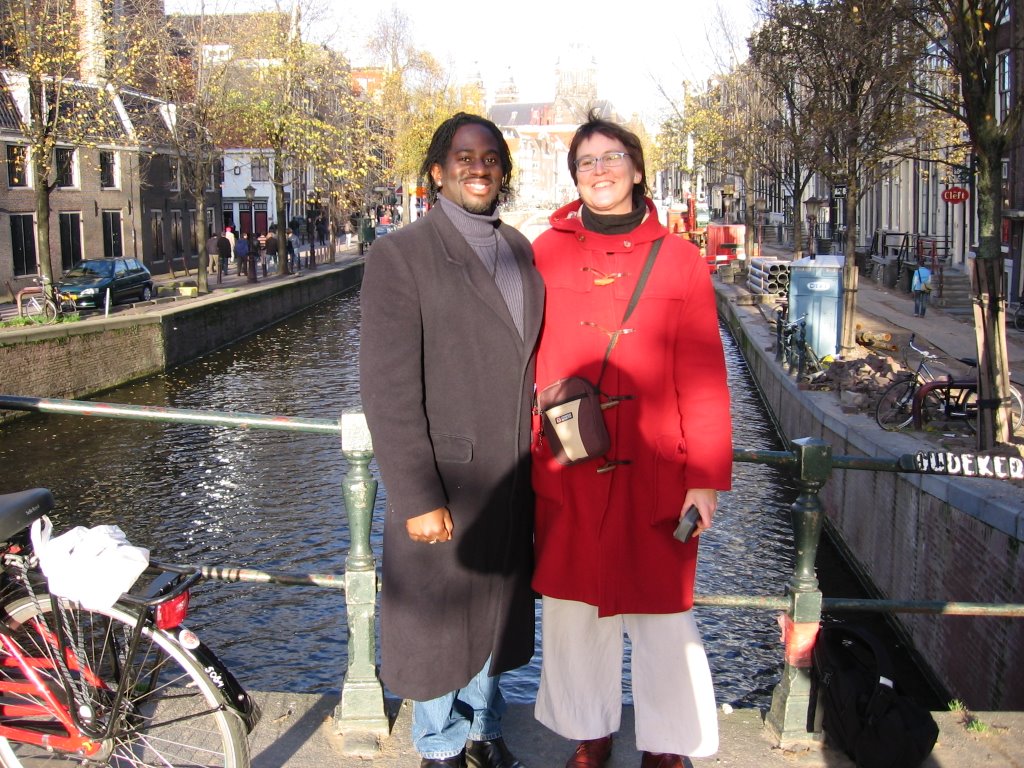 Avery and Angela
 Carriages, Canals...
 and Concupiscence
 Naughty Knickknacks
 Patently Pornographic
 Herb House
 Cocoa Confectionaries
 Fat Figurines
 Riverside Residences
 Water World (minus Kevin Costner)
 Cathedral, Carriage, and Countrymen
 Twin Towers
 Fabulous Footwear!
Subscribe to:
Posts (Atom)


